
How Long Do Knotless Braids Actually Last? A Real Care Guide
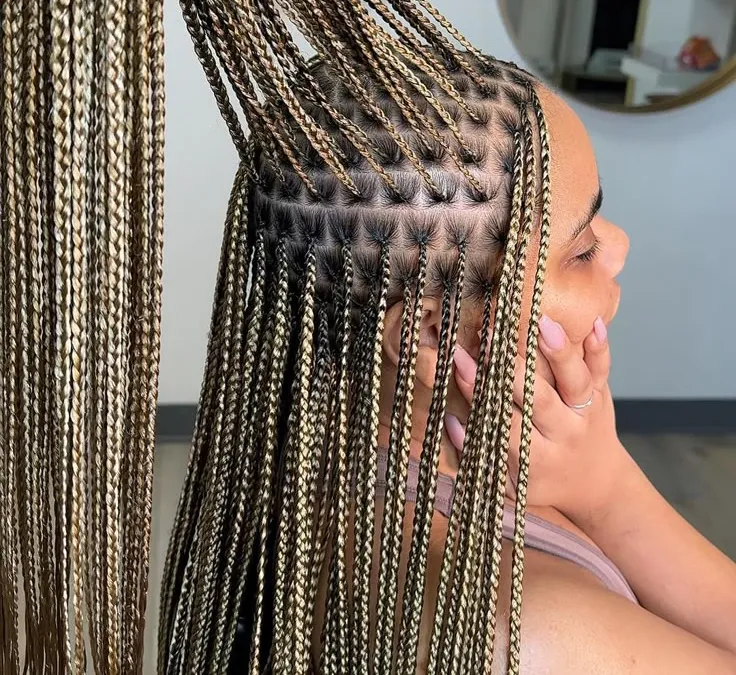
The short answer is six to eight weeks. The more useful answer is what actually happens during those weeks, what shortens or extends that window, and how to tell when it’s time to take them down instead of pushing them another week or two.
The short answer: six to eight weeks
That range holds up for most people with most braid sizes, but it’s a range for a reason. Your hair growth rate, the size of your braids, and how well you care for them at home all move that number in one direction or the other. Someone with fast-growing hair and small braids might be ready to take them down closer to week five. Someone with larger braids and a solid nighttime routine can comfortably stretch to week eight or slightly past it.
What actually shortens or extends the window
Braid size. Smaller braids show new growth sooner because there’s less hair covering more scalp, so the gap between your growth and the braid start becomes visible faster. Larger braids hide new growth longer, but they also carry more weight, which means more tension on your scalp for that same stretch of time.
Hair growth rate. This is genuinely just individual. If your hair grows fast, expect the new growth line to show up sooner, especially around your edges and part lines where it’s easiest to spot.
Product buildup. Dry shampoo, oils, and everyday sweat all build up at the scalp over weeks. Without regular light washing, that buildup traps against your scalp, which is where the itching, flaking, and odor most people associate with “old braids” actually comes from. It’s not the braids themselves aging badly, it’s what’s collecting underneath them.
How you sleep and style. Friction from a cotton pillowcase and tight, repeated ponytails both wear down the braids faster, causing frizz at the root and loose ends sooner than they’d otherwise show up.
What to expect, week by week
Weeks 1 to 2. Your braids are at their tightest and most uniform. Some scalp tenderness in the first couple of days is normal and should ease up on its own.
Weeks 3 to 4. This is usually when braids look their best: settled in, not too fresh, not yet frizzy. Expect a small amount of frizz starting at the root as your hair naturally moves.
Weeks 5 to 6. New growth becomes visible, especially at your part lines and edges. This is a good time to step up your scalp cleaning routine if you haven’t been keeping up with it.
Weeks 7 to 8. New growth is clearly visible, and matting or tangling near the root becomes more likely the longer you wait past this point. Start planning your takedown or your next appointment now instead of waiting until it becomes uncomfortable.
How swimming, sweat, and exercise affect longevity
Chlorine and salt water both dry out braids faster than everyday wear, so if you swim regularly, expect the ends to look a little more frizzy or worn sooner than the six-to-eight-week average. Rinsing your hair with fresh water before and after swimming helps, since chlorinated or salt water has less chance to sit and dry directly on the braid.
Regular sweat from workouts has a similar, smaller effect. It’s not the sweat itself that shortens a style, it’s what builds up at the scalp when sweat mixes with product and isn’t rinsed out. If you work out often, a light scalp rinse every week instead of every two weeks will keep buildup from accumulating faster than usual and help you get the full lifespan out of your set.
Signs it’s time to take them down
- Visible new growth at the root that’s changing how your braids sit
- Matting or tangling right where your natural hair meets the braid
- Ends unraveling on their own, not just a few loose hairs
- Ongoing itchiness that doesn’t calm down even after washing
None of these mean anything went wrong with your install. They’re just your hair’s normal signal that it’s time for a break or a fresh set.
How to stretch the lifespan a little
You can’t out-care your own hair growth rate, but a few habits genuinely help your braids look better for longer:
- Wrap your hair in satin or silk at night, or sleep in a bonnet, to cut down on friction and frizz
- Wash your scalp lightly every one to two weeks using an applicator bottle so you’re rinsing the scalp, not soaking the braids
- Follow with a light oil or braid spray on the scalp, not saturating the braid itself
- Skip tight buns and ponytails, which pull on the same spots repeatedly
- Moisturize your ends two or three times a week so they don’t dry out and start fraying early
Taking care of knotless braids is mostly about your scalp, not the braids themselves. Keep it clean, keep it moisturized, and protect it at night, and you’ll get the full six to eight weeks out of your set comfortably.
Ready for Knotless Braids That Actually Last?
Book with Trish and get braids built to hold up the full six to eight weeks.
Book Knotless Braids